Affinity Clusters
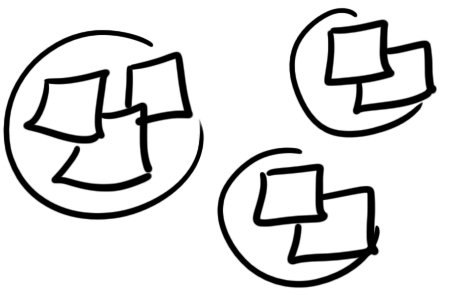
Created by Brian Tarallo
“The most beautiful order is a heap of sweepings piled up at random.” - Heraclitus
Affinity clusters start the process of converging ideas and making sense of randomness. After the brainstorming is done and there’s a critical mass of ideas on sticky notes, invite participants to group similar ideas on stickies together spatially. At the beginning, model the clustering for them. Pick up a sticky note and ask the group, “Where does this idea belong? What’s similar to it?” And move similar sticky notes together.
Some ideas may have parent-child relationships: in that case, move the parent ideas to the top of the cluster, where they effectively become the label of that cluster.
Eliminate any identical twins (for example, “eyeglasses” and “spectacles”), but hang on to similar ideas (“eyeglasses” and “contact lenses.”)
Watch non-verbal communication closely for silent disagreement, and name it: “Bob, you’re shaking your head. What do you think?”
At a certain point, I like to get out of the way and invite participants to take my place at the wall to do the work of clustering themselves. Once the movement dies down and it seems like they’ve got it, be sure to check for commitment with the group before moving on.