Engaging Adults as Visual Practitioners (So They Don’t Tune Out and Haunt You Later)
Andrea Hancock
If you’ve ever watched a room of adults slowly detach from a meeting, you know the look.
Eyes glaze.
Bodies lean back.
Phones come out like talismans against boredom.
As visual practitioners, facilitators, graphic recorders, and trainers, we like to think the markers will save us.
Spoiler: they won’t. Not if we ignore how adults actually learn.
That’s the heart of “Engaging Adults as Visual Practitioners,” a NOVA Scribes webinar led by instructional designer and graphic facilitator Andrea Hancock. The session connects adult learning principles to the way we design workshops, facilitate groups, and draw on the wall.
This isn’t just about making prettier charts. It’s about making visuals that adults can use to understand, remember, and act.
Let’s break down the big ideas.
1. Adults Don’t Arrive as Blank Slates (They Arrive as Walking Databases)
Kids show up expecting to learn.
Adults show up with:
Lived experience
Strong opinions
Scar tissue from terrible meetings
Adult learning theory (and Andrea’s work) starts with a simple truth: adults want relevance and respect. They need to know:
Why this matters
How it connects to what they already know
Where they’ll use it next
As visual practitioners, that means your job isn’t just “capture what they say.” It’s:
“Help them see how what they already know connects to what they’re learning right now.”
Practices that help:
Start your chart with a “What we already know” area. Harvest expertise before you add new content.
Use icons or sections for “Past experience,” “Current state,” “Future state” to honor where people are coming from.
When you introduce a model or framework, anchor it visually to something familiar (a process they already use, a system they know).
If people don’t see themselves in the picture, they won’t stay in the conversation.
2. Learning Retention: Make It Stick, Not Just Pretty
The webinar digs into learning retention—how much people remember based on how they engage. You can check it out here.
Here’s the short version:
Passive consumption = low retention.
Active engagement = higher retention.
So if your session is 90 minutes of talking at people while you draw, congratulations: you’ve created gorgeous wall art that nobody remembers.
Turn your visuals into retention engines:
Ask them to build with you.
“What belongs in this model?”
“What did we miss?”
“What do you see as step one?”
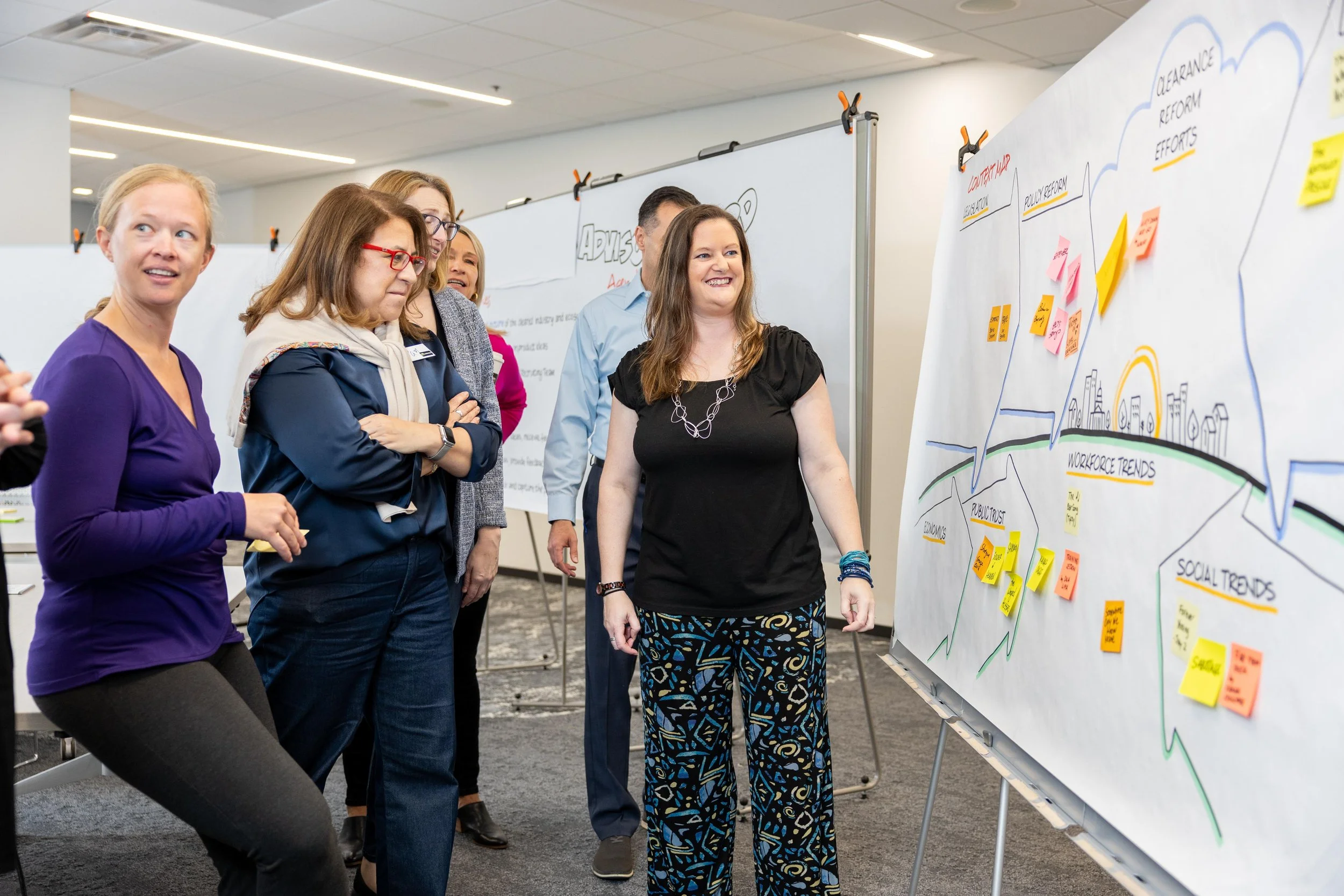
Use the wall as a working surface, not a mural.
Invite people up to add sticky notes, circle priorities, draw connections.Revisit and recap visually.
Every 20–30 minutes, step back:“Here’s what we’ve built so far.”
“What’s standing out?”
“What needs to move or change?”
The more participants move, choose, and contribute, the more the content sticks.
3. Know Your Audience (Like, Actually Know Them)
One of the webinar’s themes: “Who are you talking to?” is not a throwaway question. It changes everything—from your activity design to your visuals to your pacing.
Adults differ in:
Comfort with visuals
Cultural context
Power and positionality in the room
Learning preferences (discussion vs. reflection, big-picture vs. detail)
As visual practitioners, we love our tools. But tools without context become weapons.
Ways to design with your audience in mind:
Pre-session intel.
Ask the sponsor:“What’s the energy in this group?”
“How visual are they already?”
“What are they worried about with this topic?”
Visual empathy mapping.
Early in the session, capture:“What are you hoping we tackle today?”
“What’s one concern on your mind?”
Put those right on the chart. Now the room sees itself reflected.
Adjust the density.
Highly analytical groups may want more data on the chart. Executive groups may need fewer words and clearer headlines. You’re not just drawing; you’re tuning the fidelity.
Adults are more willing to engage when they feel seen, and not in a “we downloaded a leadership stock photo” way.
4. Engagement Isn’t Vibes; It’s Observable
Andrea talks about assessing audience engagement, actually checking whether people are with you or gone mentally grocery shopping.
As visual practitioners, we have some built-in advantages:
We stand to the side, not the front.
We watch the room while we listen.
We see where people physically orient—toward the chart, the screen, each other, or the door.
Use that vantage point.
Signs your group is engaged:
Bodies leaning forward
People pointing at the chart when they speak
Side conversations about the content (not fantasy football)
Questions that refine, not derail
Signs they’re drifting into the void:
Arms crossed, eyes down
Phones up everywhere
Long silences after questions
The same two people talking while everyone else recedes
When you see disengagement, don’t just draw harder. Change the mode:
Shift from discussion to a pair share and then have them report back visually.
Ask them to vote on the chart—dots, checks, stars.
Invite someone else to the wall: “Who can help me rename this so it lands better for your team?”
Engagement is something you work on, not something you hope for.
5. Tools and Techniques: Add These to Your Visual Toolbox
The webinar promises “new tools for your toolbox” for working with adult learners—and they translate directly into visual practice. Draws on Walls
Here are a few you can steal for your next session:
Learning-intent titles
Replace vague headings like Discussion with titles that signal purpose:“What We Need to Decide”
“Risks We’re Willing to Take”
“What Our Stakeholders Need to Hear”
Check-for-understanding icons
Add simple icons participants can react to quickly:✅ “This works”
❓ “I have questions”
⚠️ “This worries me”
Invite them to place stickers or marks near what matches their reaction.
Layered templates
Use templates that unfold in stages:First: context and current state
Second: options and implications
Third: decisions and owners
Adults stay more engaged when they can see the structure but help fill in the content.
Space for reflection
Build in a quiet, reflective zone on the chart:“Insights I’m taking with me”
“One action I’ll try in the next 7 days”
Adults don’t just need input; they need time to integrate it.
6. Why This Matters for Visual Practitioners
NOVA Scribes has always been about helping visual practitioners sharpen both the art and the practice of what we do.
Engaging adults isn’t extra credit. It’s the whole game.
A gorgeous chart without engagement is a poster.
An engaged group without a visual record has a fuzzy memory.
When you combine thoughtful adult learning design with strong visuals, you get decisions that stick and plans people actually remember.
So the next time you pick up a marker, don’t just ask:
“How can I capture this?”
Ask:
“How can I design this so the adults in the room stay awake, invested, and able to use this later?”
That’s the shift. From scribe to learning partner.
If you work with adult learners (which, unless you’re running a kindergarten retreat, you do), the “Engaging Adults as Visual Practitioners” webinar is worth a watch. Then take one principle, just one, and bake it into your next meeting.
Your markers can’t save a bad session.
But paired with good adult learning design, you’ve got something powerful.