“How” doesn’t matter
I was facilitating an offsite last week, and a participant had an insight that was so good I had to share it here.
The group was deciding on a critical issue. They were using the Gradients of Agreement to vote.
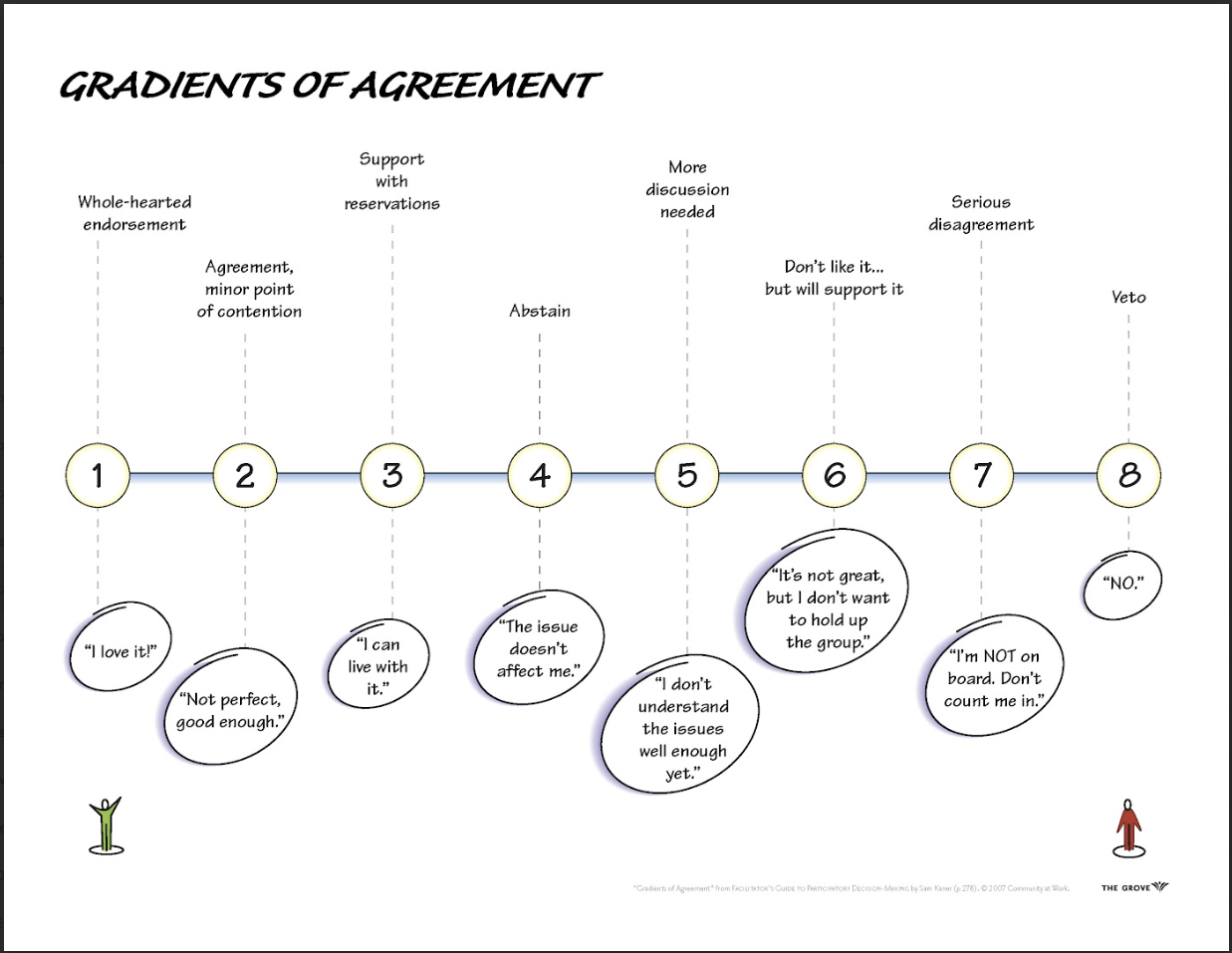
The Gradients of Agreement
The Gradients of Agreement, developed by Sam Kaner and featured in The Facilitator’s Guide to Participatory Decision Making, is a polling tool that allows for strength of preference. It’s a scale of 1-8:
1-3 are various degrees of agreement.
4 is abstain: this issue doesn’t affect me.
5 is more discussion is needed.
6-8 are degrees of disagreement.
The group used the Gradients of Agreement to see where they stood on the issue. Most of the participants voted 1-3, no one voted 6-8. A few people voted 5: more discussion needed. I asked, “What specifically is missing from the discussion so far that would allow you to vote either for or against this?” One person spoke up on behalf of the 5s: “I think I can’t vote for or against without knowing exactly how we’d implement this idea.” The other 5s agreed.
I thought it was a valid point, and was just about to open up the conversation about how, until a person who had been quiet spoke up.
“Hang on a second. We always do this. We mostly agree with the concept of an idea, but we prevent ourselves from agreeing unanimously without knowing the exact ‘how.’ I’d offer that the how is irrelevant to the decision. Why is it irrelevant? Because once we decide that the substance of the idea is worth pursuing, we always follow the same course: we weigh the options for how to get it done, and in good faith, we pursue the best options for our business. We need to do a better job of first, agreeing as a large group on the concept of an idea, and second, trusting that the few people responsible for implementing the idea will do so in good faith and with their own best judgment.”
The room was quiet. After a moment, I said, “Thanks for that. Let’s use the gradients of agreement one more time, just to see where we stand now.” The group voted all 1-3’s.
If you have a high-performing, high-trust team, how doesn’t matter. Agree on the idea, then put your faith in the people who will implement it in their own best judgment.