Systems Scribing. Because “taking notes” isn’t the same as “seeing the system.”
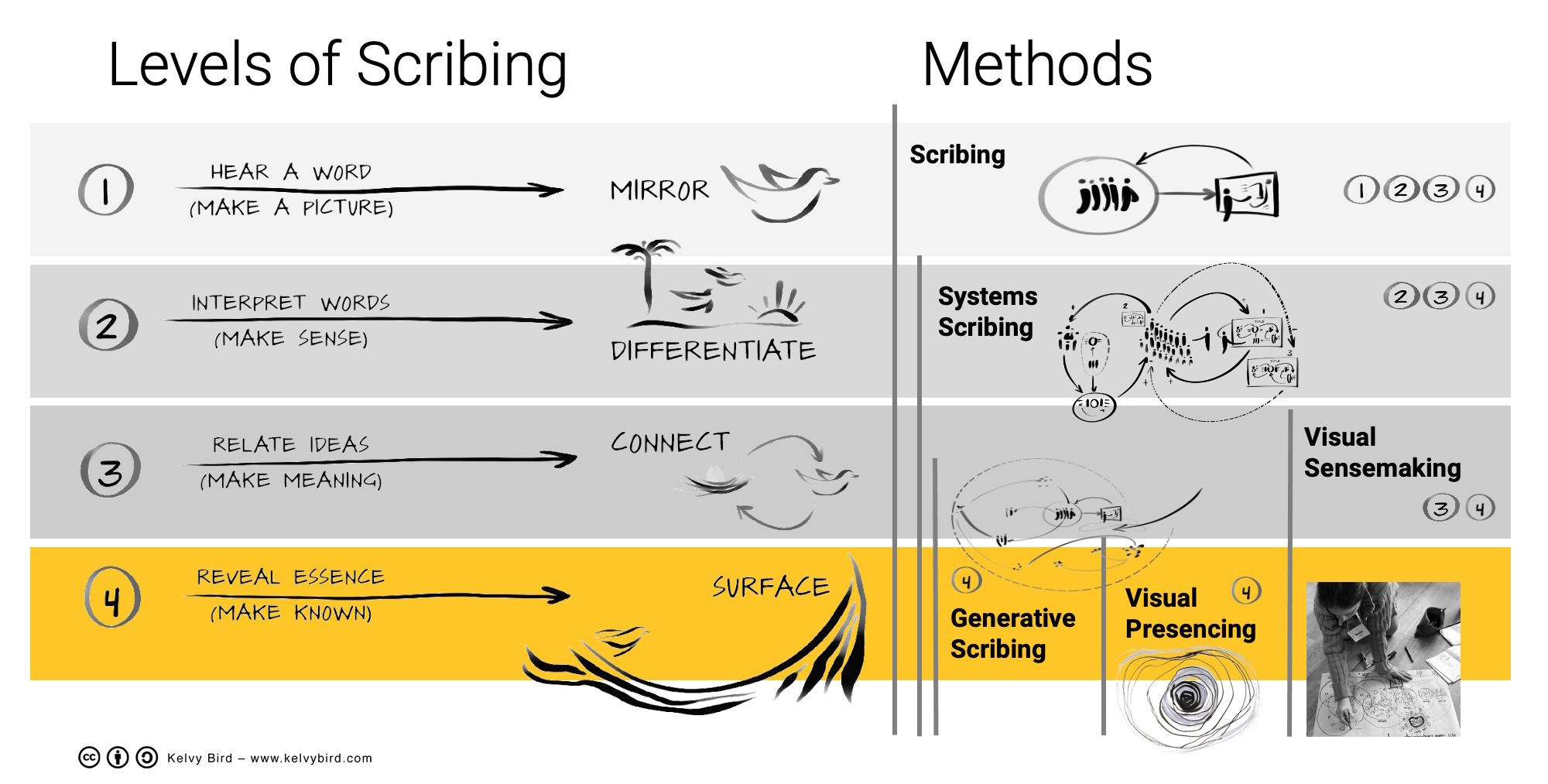
Levels of Scribing by Kelvy Bird
Some meetings feel like a horror movie where the villain is… recurring patterns. Same tensions. Same bottlenecks. Same “How are we here again?” moment, just with a different slide deck.
That’s the problem Systems Scribing is built to solve.
Kelvy Bird (featured in this NOVA Scribes webinar) teaches Systems Scribing as a blend of live visual capture + systems thinking, so the group can see not just what was said, but what’s driving what.
What Systems Scribing actually is (in human terms)
Traditional graphic recording often tracks a conversation in a mostly linear flow. Systems Scribing intentionally breaks that pattern so the scribe can map relationships, feedback loops, mental models, and interdependencies as they emerge, helping the group “see itself” and its dynamics more clearly.
In the paper Systems Scribing: An Emerging Visual Practice, Bird and Riehl describe it as the joining of scribing with systems thinking, using interpretive devices (like relationships and feedback loops) to illuminate the structure underneath group thinking—not just the content on top.
The “Levels of Scribing” lens: Why your drawings sometimes feel flat
A big piece of this webinar is Bird’s Levels of Scribing framework
Level 1 Mirror: Literal drawing (“someone says bird, you draw a bird”).
Level 2 Differentiate: Add context, cluster ideas, organize parts.
Level 3 Connect: Reveal relationships and structures (this is where Systems Scribing shines).
Level 4 Surface: Help a group make known what wants to emerge next; the drawing supports possibility, not just documentation.
If you’ve ever felt like your notes were “accurate” but didn’t change anything. You were probably stuck in Levels 1–2. Systems work lives in Levels 3–4.
A simple way to practice Systems Scribing in your next meeting
Try this 10-minute “Spot the Loop” move:
Name the repeating problem (ex: “Projects stall in review.”)
Draw 3–5 key parts (people, constraints, resources).
Add arrows for influence (A affects B).
Circle one feedback loop and label it:
Reinforcing: “more → more”
Balancing: “more → less”
Ask: “Where’s the smallest change that shifts the loop?” (That’s your leverage-point hunt.)
Even if your drawing is messy, the thinking is the win. The map makes the conversation stop, gaslighting everyone.
Watch the NOVA Scribes workshop Systems Scribing.