Visual Thinking for Problem Solvers: The fastest way to stop drowning in your own complexity
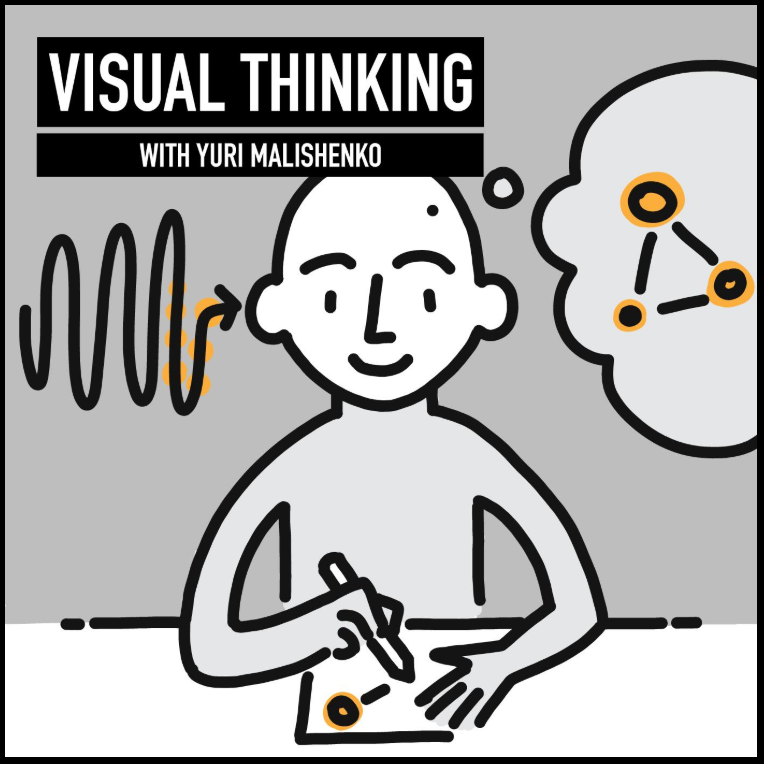
Created by Yuri Malishenko
Some problems aren’t hard because they’re “big.” They’re hard because they’re invisible.
They’re floating around as half-finished sentences, Slack threads, vague discomfort, and that one repeating meeting where everyone agrees… and nothing changes.
This NOVA Scribes webinar with Yuri Malishenko is essentially an intervention for that. It’s a practical intro to visual thinking—not as art, but as a way to externalize what’s in your head so you can actually work with it.
Visual thinking, in plain language
Yuri frames visual thinking as something you apply in your field, not a niche hobby for artsy people. The webinar promises two main arcs:
What visual thinking is and how to apply it in your work
How mapping techniques help you solve professional problems, including walking through 2–3 techniques
What I like about that framing is that it immediately moves past “visuals are cool” and into “visuals are useful.”
The three ways visual thinking pays rent
Here are three practical uses for “visual thinking for problem solvers” :
Visual note-taking
This isn’t about making pretty notes. It’s about staying engaged and actually retaining what you’re hearing. If your brain tends to wander the moment someone says “quick update,” visuals give it a job.Presenting and explaining
Visuals help you connect, create shared understanding, and build an experience people can follow. (Because “as you can see on this slide…” is often a lie we tell ourselves.)Facilitating workshops
This is where visuals stop being documentation and become a problem-solving engine—helping groups work through complexity creatively instead of arguing in circles.
Why visuals work when words don’t
Here’s the uncomfortable truth: a lot of team communication is people using the same words to mean different things.
“Priority.”
“Done.”
“Risk.”
“Alignment.”
(Shiver.)
When you draw, even simply, you force assumptions into the open. Visuals create a shared object the group can point to, correct, refine, and build from. Yuri’s own positioning emphasizes visual thinking as a way to improve productivity, communication, and collaboration, especially when problems are complex.
A ridiculously useful habit: “Map first, discuss second”
If your team tends to talk itself into confusion, try flipping the order:
Map what you think is happening
Then discuss what the map reveals
That one switch does two things:
It slows the group down just enough to reduce reactive arguing
It creates something tangible, so the conversation stops looping
The webinar’s “map along” format is built to create exactly that muscle.
Try this: the 7-minute “Problem Map” (no art degree required)
Since the session focuses on applying mapping techniques to professional situations (and not on drawing skill), here’s a simple practice you can do immediately after watching:
Step 1: Name the problem (30 seconds)
Write one sentence: “We are struggling with ______.”
Step 2: Draw the cast of characters (2 minutes)
In circles, list the key elements involved:
People / roles
Systems / tools
Constraints
Inputs / outputs
Step 3: Add arrows (2 minutes)
Draw arrows showing influence: “this affects that.”
Step 4: Put a star on the leverage point (2 minutes)
Ask: “If we changed only ONE thing here, what would shift the most?”
Star it. That’s your next experiment.
Step 5: Decide one next action (30 seconds)
Not ten. One.
Messy is fine. Useful beats pretty every day of the week.
Watch the full NOVA Scribes workshop here: https://youtu.be/zgVv6dS1lyk