The Principle of the Beachball
Created by Brian Tarallo
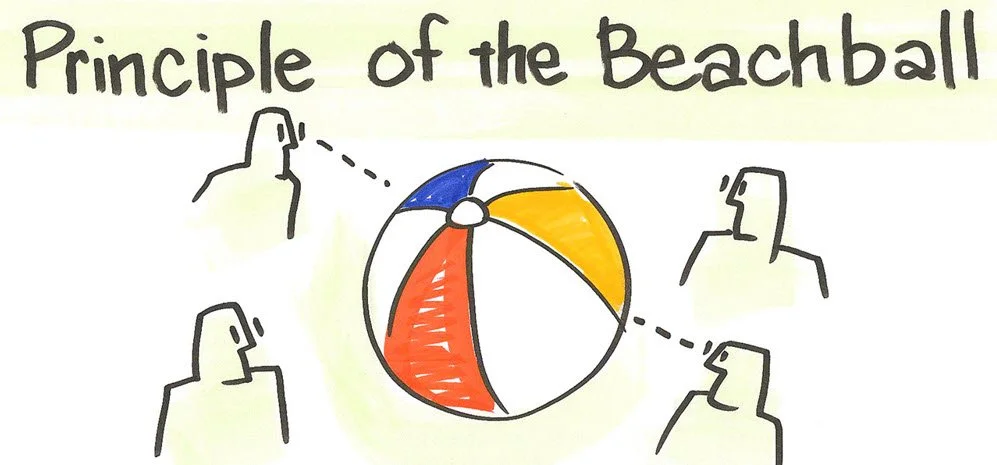
Imagine that there was a beachball in the center of the room. Based on my perspective, my senses, my expertise, my experience, everything that I am is telling me that this beachball is red. So what’s the first thing that someone on the other side of the room thinks when they hear me say that? That I’m wrong. How could that possibly be? From their perspective, the beachball is clearly blue.
The Principle of the Beachball tells us to hold the space for all perspectives. No one can see an entire beachball from one perspective; that’s impossible. And what groups work on is a lot more ambiguous than a beach ball. No one will have the one perfect perspective. There’s no such thing.
Trust in your colleagues that when they share what they share, they’re giving you a glimpse of their perspective. Challenge yourself to say, “How might all these perspectives be true?” By bringing in all perspectives, we get a clearer picture of the whole.
The Principle of the Beachball was popularized by Susan Scott's "Fierce Conversations," but traces its roots back to perspectivism, the principle that perception of and knowledge of something are always bound to the interpretive perspectives of those observing it. Perspectivism was a part of the philosophies of Protagoras, Michel de Montaigne, Gottfried Leibniz, and especially Friedrich Nietzsche.
I use the Principle of the Beachball so often that I carry a little inflatable beachball with me to help make the point. The little beachball also serves as a pretty good talking stick.